Thursday, August 7, 2014
raising money
This is the second of two fundraisers in which I have participated---for the Westmont Ridley-Tree Museum of Art, in Santa Barbara, CA. Their fundraiser is called 5X5: Celebrating Five Years, and will be on view the first two weeks of September, 2014. This year I did several sketches in watercolor, sitting at the edge of a small, person-made pond in Suttons Bay, MI, after the fair, there--and painted the fish, reeds, and frogs (who came up onto the stones next to my feet and sat in the sun while I painted. I had been given a 5"square of Rives BFK paper, along with a stamped, hard cardboard envelope, in which I will mail back the finished work. You should be able to click on the museum's name, above, and be able to go to their site and see more of the work!.
Sunday, July 6, 2014
The 2014 Ann Arbor Fair
Seems like all I am doing, lately, is uploading show information...... By fall, I should be a little more 'squared away', with all the work needed to be done to keep my business going, and I will have some time to work on the blog and etsy. We have been tearing apart (and putting back together) our old farmhouse kitchen, and I am going to be making tiles for the counter and backsplash. For now, though, it's fair season, and the big one is coming right up! My booth is A-257--the same place as last year, near the bell tower. I have some new shapes (generated from several orders that I was working on this winter). One is a long oval, a press mold shape whose form I got at Rovin's, last year. I'll post some photos of it, soon.
here are some links to the art fair, itself: www.artfair.org
The official #AnnArborArtFair app is here, so download it now!
Android users: http://bit.ly/1jjBre0
iPhone users: http://bit.ly/1ztKwG7
Android users: http://bit.ly/1jjBre0
iPhone users: http://bit.ly/1ztKwG7
Monday, March 31, 2014
Potters for Pets: a fundraiser
OK,
everybody--we are working really hard to get pots ready for this
event!!! Make sure you put it on your calendar, and come out to see
us!! The event, itself, is free; money towards the two non-profits will come out of the potters' sales and donations. Help us make a difference! For more information, click on the Potters for Pets link below the
colored ad: (or, here: Potters for Pets )
Though that may be just for fb members. The sale is at Manabigama
Pottery Center, 13270 Bishop Rd., in Bowling Green, Ohio, on Saturday,
5th April, from 5 to 9 pm. Hope to see you there! (Plus,I have a new, long, oval platter form--this will be its debut!)
Join
Potters for PetsJoin
Saturday, April 5 at 5:00pm
Manabigama Pottery Center in Bowling Green, OhioSaturday, September 28, 2013
summer fairs are over


Tuesday, August 13, 2013
a great honor!
I was one of the ten chosen for the award of excellence at the Original Art (Street) Fair in Ann Arbor, this year (ten categories, ten awards). Now back to work!!1
Friday, July 12, 2013
I'm showing at the Original Art Fair in Ann Arbor!
and here is the link to copy and enter in your browser: https://workspaces.acrobat.com/?d=Bi8tCY0JmZALgV*MnZk8jQ
or the link to click on:
Ann Arbor Original Art Fair, booth A-257
I am by the bell tower, Booth A-257, on Ingalls Mall, between E. Washington, and North University. The Fair runs from the 17th of July through the 20th; hours are: W - F: 10 - 9, and Saturday: 10 - 6. See you There!
or the link to click on:
Ann Arbor Original Art Fair, booth A-257
I am by the bell tower, Booth A-257, on Ingalls Mall, between E. Washington, and North University. The Fair runs from the 17th of July through the 20th; hours are: W - F: 10 - 9, and Saturday: 10 - 6. See you There!
Thursday, June 6, 2013
So, Finally, I got my kiln rewired!...
So, Finally, I got my kiln rewired!! And it wasn't really all that hard. (Remember how bad it used to be? Elements looping down along the inside wall, totally out of their grooves? It was still reaching temperature, until that fateful firing during Art-O-Matic in Toledo this spring......) So I finally ordered the replacement parts to do the entire set of 6 elements (but not the switches--they were fine) I also ordered a replacement kiln sitter ceramic sleeve. They came from Runyan Ceramics in Clio, Michigan. When they came, I set aside a day to work on the kiln. It all went very well (and thanks to Paul at Runyan's for the technical advice!) I just wasn't able to cut off the end of the loops on each end of each element, nor crimp the sleeve that goes over the element wiring and the wiring to the switch, connecting the two. So, I got Bruce to do that for me (though I understand, from my friend Robert Rueger, who roasts coffee and sells it at the Toledo Symphony, that there are $150 ratcheting crimpers which would do the job very nicely, without the bone-crunching effort.) Now the kiln not only looks good; it fires like greased lightening.
Sunday, April 28, 2013
demi-lune, in progress
I'm finally finishing a demi-lune that has been sitting on my glaze table for about three months (or more). And because doing landscapes is hard (you don't see exactly what you're going to get), I usually work on several at a time, and get ideas from one to the other. Here are two photos: one, of how the demi-lune looked for several months, and, another, of how it appeared after more color and structure had been added. The next blog will show the finished tiles; however---I have to say, my old kiln which needed rewiring finally broke during the glaze firing, yesterday, and never quite reached temperature. I may have to re-fire.
Tuesday, April 16, 2013
Yunomi Invitational--more to come--opens on Friday, 19 April 2013
4/19/2013 - 5/17/2013
2013 Yunomi Invitational
(ONLINE ONLY) 200 Potters, 5 Yunomi each for AKAR's 2013 cup show. Donations to Studio Potter Magazine.
the show is open, now, and work is selling!
2013 Yunomi Invitational
(ONLINE ONLY) 200 Potters, 5 Yunomi each for AKAR's 2013 cup show. Donations to Studio Potter Magazine.
the show is open, now, and work is selling!
Wednesday, March 20, 2013
a landscape tile--a second look
In the early evening, as the sun is going down, and the light through the west windows is warm and encouraging, I sometimes sit in the old chair that my dad used to sit in (with his kitty, Gus, who now lives with Janet Kelman) and share a glass of wine with Bruce, and take a moment to reflect on what I'm doing, and at such a breakneck pace. I often miss seeing things that I might really like, but for the fact that they didn't sell last season, and are now hanging on the wall just opposite the chair, and, hmmmm.....so I have the chance to take another look.
Monday, February 18, 2013
Oval forms: final finishing work-----Part three
![]() |
| a. smoothed and ready for the handles |
Then I pull long coils, and twist two together. Two lengths are cut simultaneously, so that they will be even, and with a little vinegar I add them to either end of the casserole form (illustration 'b'). These are the 'braided' handles.
![]() |
| b. adding the handles |
![]() |
| the finished leatherhard form |
![]() |
| c. the under side of the casserole, which is glazed and decorated.. |
Tuesday, February 12, 2013
Oval Forms; slab-built: part two
![]() |
| cutting out the patterns |
![]() |
| bevelling the edge |
Once I've tested the patterns with an actual clay trial form, and know that the patterns are going to work, I roll out a clay slab, flipping the slab over each time I roll it. To keep the slab even, I use two 1/4 inch dowels on either side, like train tracks, on which the rolling pin can roll. The table surface is a piece of granite, smooth, and slightly absorbant. The sheeting (part polyester--doesn't wrinkle as much....) makes it easier to lift the slab, each time it's rolled out, so that I can flip it over before I roll it out, again. Then I cut as many forms out of one slab as I can fit--I hate having to recycle the slabs if I don't have to! The oval base goes into the bottom of the plaster mold, and its outer edges are pressed and thinned once the base is in place. The side pieces get a bevel cut at each end, where the ends will overlap each other. The top edge of the curved side piece is smoothed, now, as well.
![]() |
| placing the cut shapes into the mold |
Once all the pieces are in place, (I scrub the areas to be joined with a toothbrush dipped in vinegar) they're smoothed down, and pressed against the bottom and side with my fingers. I also put a soft coil around the oval, at the inside base of the piece, and up the sides at
the joining of the two sides.
![]() |
| fitting the side pieces on top of the base |
Final work on this piece will continue in a third post.
Sunday, February 10, 2013
Oval forms; slab-built
![]() |
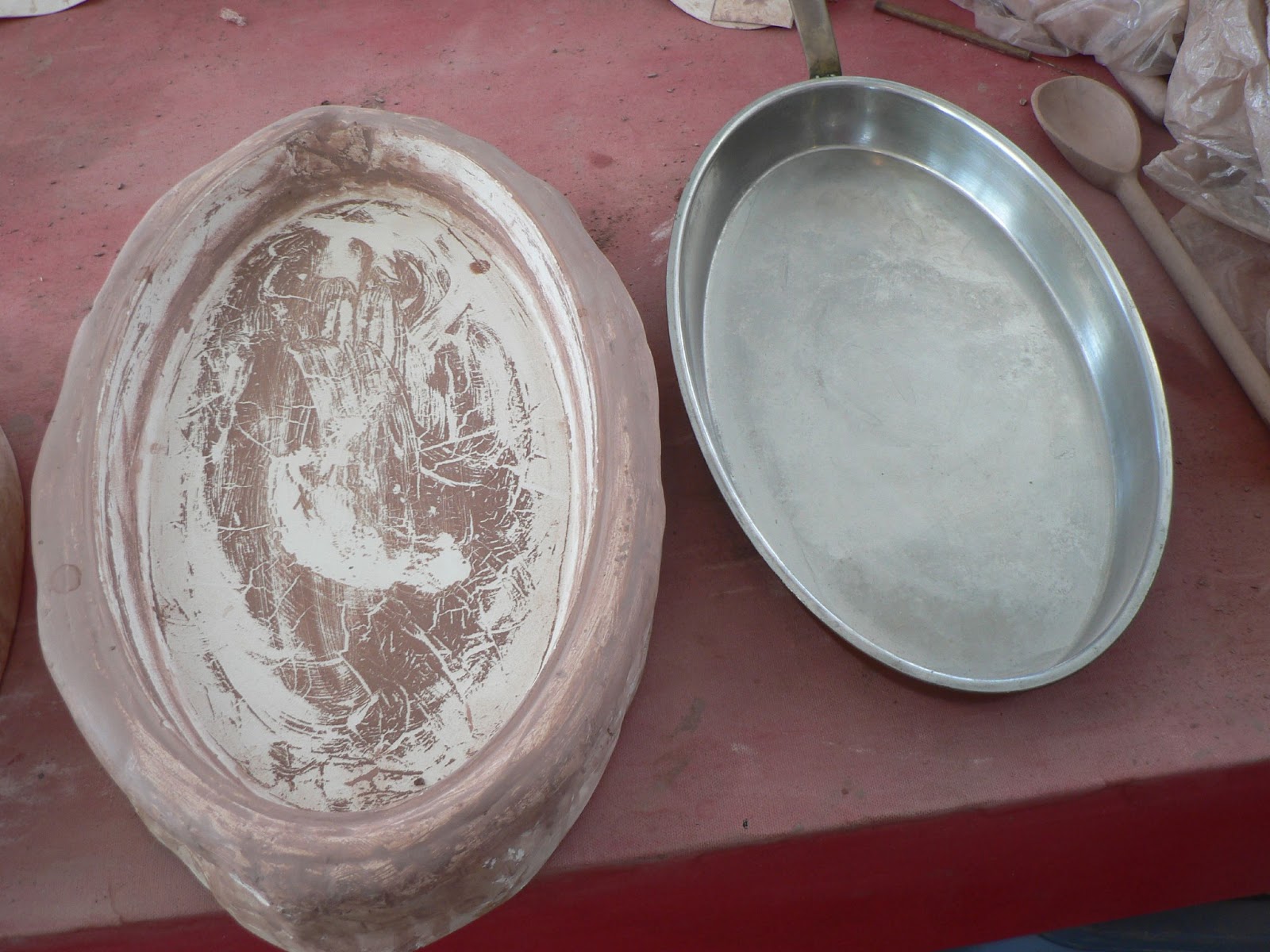
| this first form was cast from a flat pan (seen to the right) |
![]() |
| some of the oval shapes I work with; the one on the right is the commercially made mold |
In order to make the patterns, I first work with a lightweight paper like newsprint. To start, I push a slightly larger oval piece of paper into the bottom of the mold. Then I run my fingers around the outer edge of what I perceive to be the bottom until I can see where to cut the oval base shape. Then I take a pencil and draw the cutting line, and then cut the shape, itself. I then do the same thing with one-half of the side. The shape of the side is something like the shape of a lampshade that is laid out on a flat surface. It's like a rhomboid (OK, not really, but...) with a curved top and bottom edge. These first thin paper patterns are done on a trial basis, and, after using them to cut out the initial clay forms, and after pressing the clay forms into the plaster mold, adjustments can be made so that the pieces fit together more precisely. The third image, here, below, shows the final patterns, (along with one of the finished and fired pieces). The final pattens are made from a sort of plastic paper: impossible to tear, and fairly easy to cut with sharp scissors. It was 'paper' given to me when I was a den mother for Pete's cub scout group. I was never able to figure out what to do with it with the boys, but, years later, I discovered that it made good patterns for cutting out clay shapes. It's strong enough to be laid on wet clay without wrinkling up, and strong enough to have a needle tool run around its outside edge, over and over, without distorting. In the next post, I'll show how the clay is cut and placed into the plaster mold.
![]() | ||||
| Here is the mold (which I call 'long'), with its patterns, and with the finished pot |
Saturday, February 2, 2013
mid-winter gallery displays, part 2---
Sunday, January 27, 2013
a new shape
![]() |
| the new plate shape |
Friday, January 25, 2013
patterns for inspiration--from Alisa
I had finished a number of the four-legged pots, and now needed to decorate them. Because of their form, with the little legs, and twisted handles, and the inside/outside aspect, there are all sorts of ways I can approach the problem. This winter, for Christmas, from Alisa Mazur, I received a set of hand-made cloth zippered bags which had a very intriguing set of patterns, so I decided to take them out to the studio and try some of the combinations of stripes, flowers, and colors. Here are a few of the beginning applications:
Monday, January 21, 2013
Mid-winter gallery displays, part 1
![]() |
| my work on the beautiful cherry table at the Hudson Gallery, downtown Sylvania, OH www.hudsongallery.net |
Tuesday, January 1, 2013
![]() |
| demi-lune finished in late November, 2013 |
Friday, December 28, 2012
just before the studio sale---
Just before the studio sale in early December, I decided to 'twig' the two demi-lune tile sets. It's an addition I learned from my friend Will Case-a jeweler in northern Michigan. I had been using a small drill bit to drill small holes, and then was nailing in small nails to hold the branches (wild cherry, apple) in place. Bruce saw me struggling, outside, in the cold, and said: "why don't you use the pin gun (works on compressed air, a Senco). So, I did, being careful not to shoot a 'nail' into any of my fingers. I also used some of the wild grape vines that I had been trying to cut out of the crabapple trees. It's amazing how easy a job can be with the right tools.........Just be sure to follow proper safety standards!: Eye protection, etc!
Friday, November 9, 2012
Sale of Edith Franklin's final works, tools, memorabilia, and donations of other artists' works
- 1:00pm until 4:00pm
The Secor Gallery, 425 Jefferson Ave., Toledo, OH 43604
Celebrate the life of Edith Franklin and help support Edith's life and work, and the Youth Arts Fund she created to ensure the promise of Toledo's young artists of the future. Join us as we celebrate at the Secor Gallery, 425 Jefferson Ave., Toledo on Sunday, November 11 from 1-4 p.m. Selected archival works by Edith and personal mementos will be sold at her request, along with other local artists' works donated in her honor. All event proceeds go to the Edith Franklin Youth Arts Fund at the Toledo Community Foundation. Donations to the fund may be made at the event or mailed to The Arts Commission (1838 Parkwood Ave., #120, Toledo, OH 43604). RSVP requested, 419-254-2787.
Sunday, September 30, 2012
selling my potter's wheel chair
I am selling a potter's chair/stool which I
bought to use with my sit=down wheel (when my hip/back was bothering me)
Now that I have had hip replacement surgery, I no longer need the
chair, and am selling it on ebay--if you go to the ebay link and enter
290782517949 in the search box, you can see the link------
Saturday, September 29, 2012
Studio Repairs
![]() |
| shakes are going up on the gable end (to match the house) |
![]() |
| Tar paper, before the cedar clapboards |
Sunday, September 23, 2012
Thursday, August 23, 2012
I SHOULD be throwing mugs, but....
the leather hard tiles, back in 2010, when I was musing about where they would go
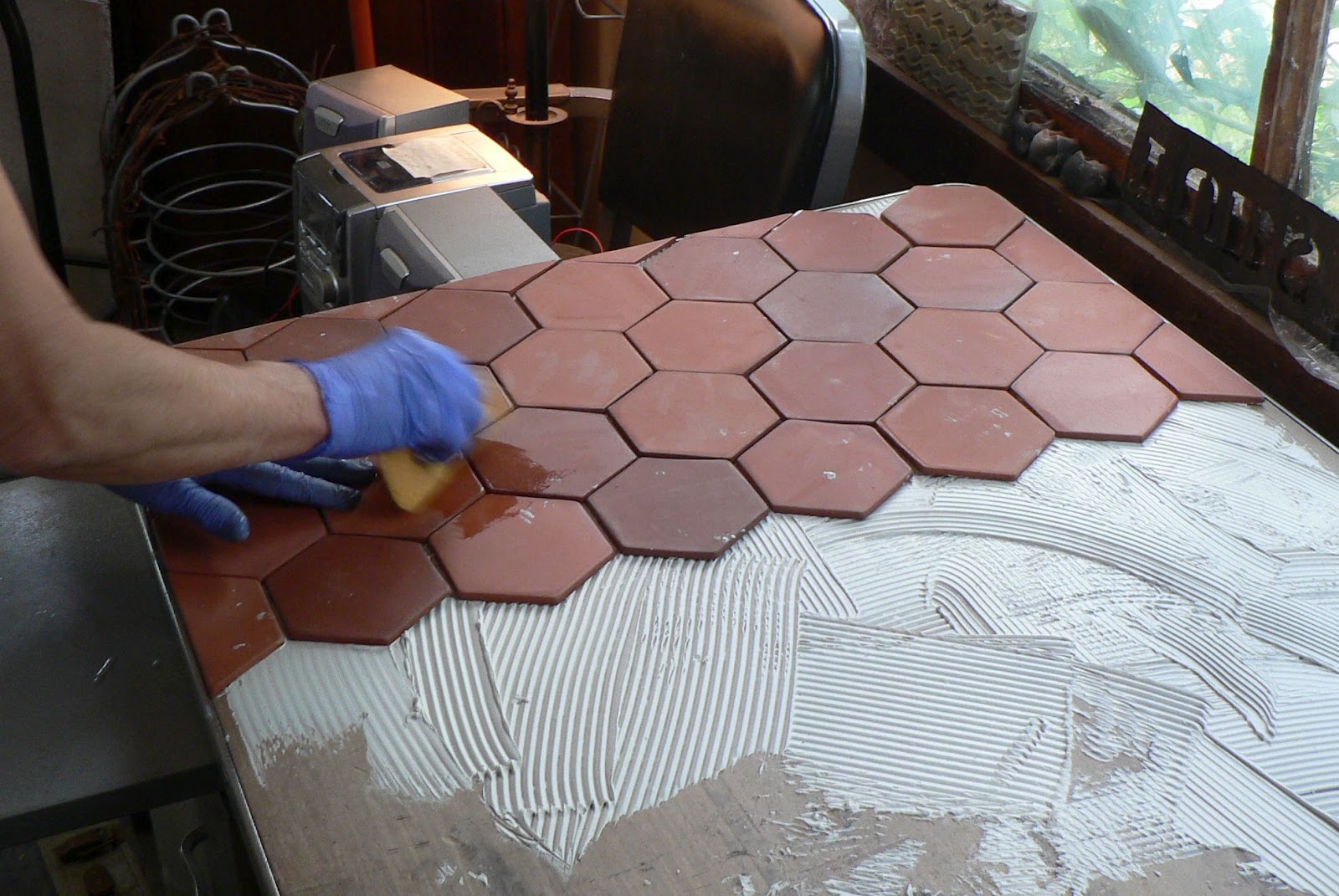
For a number of years I have wanted to fix up the top surface of the old Steelcase desk that has been in my studio. It actually belongs to our son, Pete, but I am 'storing' it, and have painted the drawers and sides. But the top remained a little raw, so this week I decided to tile it. I had done tiles (4" hexagonal, unglazed, fired to cone 2) which I thought I might adhere to the foundation of the house up by the porch. But I only had enough to do one section, and once I started looking at the area, I realized that I had an old farmhouse on fieldstone foundations, with a kind of cement covering to the foundation, and the tiles would be out of character, and I probably would need years before I got enough done to do the whole house. Instead, I decided to tile the top of the desk! I wanted it to remind me of the old tile floors in France---
![]() |
| the finished desk top |
![]() |
| buttering the back of the tile |
![]() |
| spreading more mastic |
![]() |
| setting the tile into the mastic |
![]() |
| wiping off the extra mastic. |
Saturday, July 21, 2012
My work at the Ohio Craft Museum, Columbus, OH
I have work at the Ohio Craft Museum in Columbus, OH, http://ohiocraft.org/ and Ann Starr, in her recent blog, reviewed the work--here is the link for her blog! http://starr-review.blogspot.com/
upgrading the exhaust vent window 'exit'
![]() |
| new way of exiting the hot exhaust pipe from the kiln |
Many years ago (15, more or less) when I bought my new kiln, I added the "enviro-vent" to the base of the kiln, and vented the kiln, via a rigid 4" metal pipe, to the outside of the studio. At the time, and with my limited skills in construction (but fertile imagination as to how something might be), I fashioned a way of taking the exhaust pipe out through an adjacent window without having to break any glass, or do too much fussing. I opened the window, and then inserted a 2" piece of rigid foam insulation, into which a 4" hole had been cut, at the bottom edge. Then I put the pipe through this hole, and voilà ! The pipe exited the building without much fuss----with the pipe essentially rested on the wooden window sill. As time passed, however, and as I changed out the rigid pipe for a flexible pipe this last year, I felt, more and more, that the temperature of the pipe was fairly hot, and that my method of construction wasn't the best. I also knew that wood, exposed to high heat over time, undergoes a change, and eventually has a lower flash point for catching fire. SO, about 2 weeks ago, during one of our increasingly hot spells, and as I was starting the last kiln, I convinced Bruce to help me put in a safer exit hole for the exhaust pipe. He found a collar from one of our woodstoves (we used to heat both the house and studio with them) which wasn't being used, and which was large enough for the piping to pass through. Then we took off the (black) plastic from the outside of the window, and the styrofoam from the inside, shut the window, and removed a pane of glass. On both the outside and the inside of the window, just slightly larger than the pane of glass, he put two pieces of plywood, into which a hole had been cut, large enough for the insulated stove collar to fit. Now the hot piping no longer touches either the wooden sill, or the styrofoam. When winter comes, and I need to cover the window, again, I'll be making more changes........
Thursday, July 19, 2012
layering patterns for 'surface depth'
As I decorate a pot (the large flower pot, from the last post), I follow a series of decisions. The first has to do with what 'theme' I'll use on the pot: lemons, olives, hand with red pears, part of another decorated plate, etc. Then I usually work with the largest forms for that particular theme, and lay down the lightest, largest color shapes, setting the pattern (or, working out what I might want the pattern to be) for the shape that I'm decorating. For example, I'll do lemons, and leaves, first, then smaller forms (grapes or olives, branches, and stems, and thin grey leaves). The background is the last to be considered, and is sometimes, but rarely (these days) left entirely white. I want the viewer's eyes to travel around the space, and I want there to be a sensation of depth, so I decorate the 'white' areas with smaller lines and swirls. Low fired maiolica has a tendency to be flat in appearance; the glaze and clay, fired to cone 03 or 04, do not fuze to the extent that a cone 2 maiolica firing does (and I fire to cone 2). So, in addition to the higher firing, I then add smaller lines, dots, and swirls with a very fine brush, or very small brush, or with a brush that has been opened up so that the bristles paint two closely parallel lines. I also shade, with a pale taupe, each of the larger forms before I add the final black lines that go around the shapes.
Sunday, July 15, 2012
loading the kiln in summer
![]() |
| the kiln gapes open in the background, waiting to eat up whatever I can decorate |
| after the kiln is loaded, the colors are scattered and drying out |
Sunday, June 24, 2012
Setting up, and Saturday at the Fair
Subscribe to:
Posts (Atom)